Saturday, September 29, 2012

SPLAT THE CAT by Rob Scotton


Bibliography:
Scotton, Rob. 2008. Splat the Cat. New York: Scholastic Inc. ISBN 9780545198660

Plot Summary:
Splat is worried about his first day at cat school. However, after a persistent mother and class full of friendly fellow feline students welcome him to the world of education, Splat finds that he really does like school after all.

Critical Analysis:
Scotton's expressive illustrations and relateable character provide a perfect avenue for children to connect their own feelings with those of the lovable Splat the Cat. Children can relate with this tale of going to school and the anxiety that comes along with starting any new endeavor. They will laugh at Splat's creative arguments that his hair, house, and yard won't let him go to school, he better put it off until later. They will feel his great relief when he is given a great big cat welcome by his new fellow classmates. And they will feel Splat's excitement when he learns the important truth that he, like all children, is amazing. Scotton's heartfelt picture book is a great way to ease new and reticent young scholars into the exciting world of school.

Scotton's illustrations are crisp and full of wonderfully funny details like fish bone wallpaper and little white chocolate mice at the candy store. He perfectly captures through his characters expressive feline faces the emotions of his characters as they go thorough the first day of school for Splat. The vivid illustrations compliment this universal story of first day jitters while at the same time providing beautiful detail to create the rich, complete world inhabited by Scotton's very human felines.

Reviews and Award(s):
School Library Journal: “The fuzzy black feline is worried about his first day of school, and despite determined attempts to avoid the inevitable, he ends up there. School is a combination of fantastic revelations and baffling mysteries....This lighthearted story, told with a generous helping of humor and goofy characterizations, will have broad appeal. The backgrounds are full of great details, like the fish-bone wallpaper in Splat's room and one of his classmates clutching a Russell the Sheep doll. There is something new to find with each reading. The use of monochrome in the illustrations, with a touch of color here and there, emphasizes the idea of school as a place of uniformity where fresh ideas are allowed to break through. Splat is a welcome addition to the first-day-jitters canon and a fun book to read any time of year.”
Booklist: “Splat’s very visible, very childlike enthusiasms and concerns will resonate with kids, who will flip through the pictures more than once.”

Connections:
*Splat the Cat is a story about Splat's first day of school. Think about your first day of school. How did you feel about going to school? Did anything special or funny happen that made the day memorable? Did you do anything special? What do you remember most about that day? Draw a picture of write a narrative about your experience and share it.
*It is normal to feel worried about starting something new, just like Spat was worried about starting school for the first time. Come up with a few strategies for dealing with feeling worried or anxious. Practice these relaxation and coping techniques.
*Other books about the first day of school:
Penn, Audrey. The Kissing Hand. 978-0878685851
Wing, Natasha. The Night Before Kindergarten. 978-0448425009
Danneberg, Julie. First Day Jitters. 978-1580890618

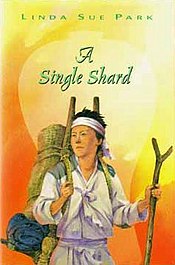
A SINGLE SHARD by Linda Sue Park

Bibliogrpahy:
Park, Linda Sue. 2001. A Single Shard. New York: Sandpiper. ISBN: 978-0547534268

Plot Summary:
Tree-ear is a homeless young orphan who lives with is friend and mentor, Crane-man. One day, from obligation to repay an unfortunate debt and a bit of quick thinking, Tree-ear is able to become the apprentice to the most gifted potter in his small medieval Korean village. As Min and Tree-ear labor at the art of creating beautiful pottery an emissary from the emperor comes to their small village looking to award a royal commission to the finest potter. The entire village steps up to the challenge, each potter seeking to prove his worth and skill, but only one can receive the coveted commission. Through hard work, humility, and perseverance Tree-ear is able to find a home, pursue his love for pottery, gain a family, and help his master secure the royal commission.

Critical Analysis:
Park's story of a young man's journey into adulthood in medieval Korea resonates with timeless lessons and experiences that people of all ages can relate to and learn from. Tree-ear, the protagonist, learns lessons in hard work, perseverance, honesty, loyalty, courage, and love. Filled with important life lessons, A Single Shard is the perfect book to share with readers of all ages and walks of life.

Awards and Review(s):
2002 Newbery Medal Book
2002 ALA Best Book for Young Adults
2002 ALA Notable Book for Children
2001 Booklist Editor's Choice
2001 Capitol Choices Selection
2001 School Library Journal, Best Books of the Year
2001 New York Public Library, 100 Titles for Reading and Sharing
Publishers Weekly: “Park molds a moving tribute to perseverance and creativity in this finely etched novel set in mid- to late 12th-century Korea.”
School Library Journal: “This book will engage both individual readers and discussion groups;”

Connections:
*Tree-ear must face a difficult ethical choice of whether or not to tell Min of another potter's secret. Think of a time when you have had to make a difficult choice that tested your understanding of honesty and ethics. What choice did you make? How do you feel about your decision? What did you learn about yourself from this experience?
*Other books by Linda Sue Park:
Seesaw Girl. ISBN: 978-0547248882
When My Name Was Keoko. ISBN: 978-0547722399
The Firekeeper's Son. ISBN: 978-0547237695
The Third Gift. ISBN: 978-0547201955
Bee-Bim Bop!. With Ho Baek Lee. ISBN: 978-0547076713

Monday, August 6, 2012

THE GRAVEYARD BOOK by Dave McKean


  1. 1.  Bibliography
Gaiman, Neil. 2008. The Graveyard Book. Ill by Dave McKean. New York: Harper Collins. ISBN 9780060530945

  1. Plot Summary
When still only a toddler, Nobody Owens (Bod for short) escaped the murderous grasp of the frightening villain, the man Jack. Taking pity on this helpless and now orphaned child, the Graveyard takes Bod under its protection where he is raised by Silas, the mysterious graveyard caretaker, and a doting ghostly couple, Mr. and Mrs. Owens. As Bod grows up he seeks to find out more about his past and find his place in the world.  But, before he can leave the safety of the Graveyard, he first must learn to navigate the foreign world of the living and defeat the deadly murderer, the man Jack.

  1. Critical Analysis
Gaiman opens his darkly humorous and touching tale of a young man coming of age with the riveting opening line, “There was a hand in the darkness, and it held a knife.” From this compelling opening to the last line of the novel, Gaiman masterfully guides readers through Bod Owens' unorthodox upbringing. Surrounded by ghosts, ghouls, and caretakers who belong to neither the world of living nor the dead, Bod grows up with everything a boy needs. His ghostly parents give him love and guidance. Silas provides him with food, clothing and advice. The Graveyard protects him from the ever searching eye of the man Jack. And Bod finds friends and companions among the various ghostly residents of the ancient cemetery. But, as all children know, one cannot live forever under the protective gaze of one's guardians. One day he must be brave enough to go out and face his life and make his own adventures. That is exactly what Bod sets out to do. Gaiman's unorthodox tale of growing up and letting go will resonate with readers of all ages.

Dave McKean's illustrations are sprinkled throughout the novel, highlighting key events in the story and bringing the world of Bod's graveyard home to life. His slanting lines and slightly distorted depictions of characters and events add to the sense of the macabre that go with Bod living among the dead and dealing with demons and ghouls as part of everyday life. They add to the wonderful atmosphere of Neil Gaiman's masterful writing.

  1. Awards and Review Excerpt(s)
*Newbery Award
*Carnegie Medal
*Hugo Award
*Locus Award
*ALA Notable Children's Book
*ALA Best Book for Young Adults
*Starred review in Kirkus: “Wistful, witty, wise—and creepy. This needs to be read by anyone who is or has ever been a child.”
*Starred review in Booklist: “An utterly captivating tale…this is a rich story with broad appeal and is highly recommended for teens of all ages. ”
*Starred review in KLIATT: “Gaiman has a true gift for narrative and a delightfully light touch, and there are humorous details along with spine-chilling ones. YAs will race through this fine tale and enjoy every magical, creepy moment.”

  1. Connections
*Bod Owens is told to stay away from the edge of the graveyard where the less desirable ghosts are buried. Wanting to understand these mysterious ghosts better, Bod find himself befriending the witch buried at the edge of the graveyard, Liza Hempstock. He recognizes her basic humanity and gains an unshakable friend in the process. Relate Bod's experience to your own personal experience.  Talk about a time when you may have befriended someone who on the outside didn't look or act according to social norms. What did you learn about that person? What did you learn about yourself? If you haven't had this experience, consider befriending someone outside of your normal comfort zone and see what happens.
*While attending public school Bod must learn to deal with bullies. Talk about Bod's solution to stop bullying in his school. Did he handle the situation in the right way? What would you do the same and what would you do differently? Talk about bullying in your school. What can you do to stop any bullying issues that might be happening around you?
*Other books by Neil Gaiman
Coraline. ISBN 0380807343
M is for Magic. ISBN 0061186473
Odd and the Frost Giants. ISBN 0061671738
Stardust. ISBN 0062200399

THE SCORPIO RACES by Maggie Stiefvater

  1.  

    1.  Bibliography
 Stiefvater, Maggie. 2011. The Scorpio Races. New York: Scholastic Press. ISBN 9780545224901

  1. Plot Summary
Last fall Puck (Kate) Connolly and her two brothers were suddenly orphaned when their parents were killed by the wild Capaill Uisce water horses during a fishing trip. The orphaned siblings have been struggling to make ends meet ever since. Puck has never gone to the Scorpio Races, but this year she joins them. She must win the race to save her home, keep what is left of her family together, and ensure her place on the wild and unforgiving island she loves.

Sean Kendrick was orphaned when his father was killed by the deadly water horses during a Scorpio Race. Since that fateful race Sean has ridden in the Scorpio Races on his stunning Capaill Uisce, Corr, because he can't image doing anything else. This time, however, is different. This year he races for the right to own his beloved horse and gain his independence from the manipulative Mr. Malvern. As Sean and Puck both race for survival they learn the true meaning of home, family and love.

  1. Critical Analysis
Set in a world that is both strange and familiar, Stiefvater sets her timeless story of courage, perseverance, and claiming one's own destiny in an alternate reality. Stiefvater weaves the familiar with the magical as she tells a tale of a dangerous race held since before remembered history, the Scorpio Races.  Each Fall the inhabitants of Thisby must capture and subdue the dangerous aquatic predators known as Capaill Uisce, and race them. Stiefvater uses these horses and the races they inspire as the catalyst for her compelling tale of one young man finding the strength to give up everything he knows in order to have the opportunity to have everything he dreams for, and of one young woman's desperate attempt to hold her family together against all odds. Readers will identify with this story of growing up and finding a place in the world. This is a wonderful book for those who enjoy horse stories, love stories, fantasy stories, and stories of human triumph.
  1. Awards and Review Excerpt(s)
*Mythopoeic Fantasy Award Finalist
*Horn Book Best Books
*School Library Journal's Best Books of the Year
*Michael L. Printz Award Honor
*NCTE/CLA Notable Children's Book in the English Language Arts
*Westchester Fiction Award
*Starred review in Kirkus: “[A] taut, chilling, romantic adventure....Masterful. Like nothing else out there now.”
*Starred review in The Horn Book: “Stiefvater masterfully combines an intimate voice (think I Capture the Castle) with a fully evoked island setting with sensory-rich language (think Margo Lanagan) with a wealth of horse detail with a plot full of danger, intrigue, and romance. ... Stiefvater sets not one foot wrong as she takes readers on an intoxicating ride of their own. ... Stiefvater’s novel begins rivetingly and gets better and better…all the way, in fact, to best.”
*Starred review in Booklist: “A book appealing to lovers of fantasy, horse stories, romance, and action-adventure alike, this seems to have a shot at being a YA blockbuster.”

  1. Connections
*Puck loves her horse, Dove, and spends a great deal of time caring for her. Take a page from Puck's book and learn more about horses.  Find out about the different breads and what it takes to care for a horse. You can start your research by checking out several books about horses from your local library.
*Sean Kendrick comes from a long line of Capaill Uisce racing experts. It seems to be a multi-generational family trait.  Find out about your own family and see if there are any special qualities or traits which seem to follow down with each generation. Celebrate this quality by creating a piece of artwork or by writing a poem about it. Share it with your family.
*The Connolly children have to work very hard to support themselves after the deaths of their parents. To better understand their struggle learn about what it takes to financially run a household. You can ask your parents or another respected guide to show you how they manage finances. You might even try coming up with a personal budget to practice managing your own money better.

LUNCH LADY AND THE LEAGUE OF LIBRARIANS by Jarrett J. Krosoczka


  1. 1.  Bibliography
Krosoczka, Jarrett J. 2009. Lunch Lady and the League of Librarians. New York: Alfred A. Knopf. ISBN 9780375846847

  1. Plot Summary
While eagerly anticipating the release of the new X-Station 5000 game station and the upcoming read-a-thon, the Breakfast Bunch and Lunch Lady sense that something is wrong with their normally genial school librarians. To their horror they uncover a dastardly plot by the League of Librarians to destroy all of the X-Station 5000 game systems and gain world domination. Lunch Lady, with the help of the Breakfast Bunch, must use her crime fighting skills to put a stop to their evil plans, keep the X-Station 5000s from certain destruction, and save the read-a-thon before it is too late!

  1. Critical Analysis
Young readers will never look at school the same way after reading Krosoczka's delightful Lunch Lady graphic novel series. Readers soon learn that looks can be deceiving as they join in the crime fighting escapades of Lunch Lady and her unexpected student sidekicks, the Breakfast Bunch. In Krosoczka's graphic novels, Lunch Lady is “Serving Justice! And serving lunch!” Krosoczka reminds readers in a delightfully energetic, creative, and action packed way that even the most humble of people have great potential for becoming extraordinary.   Using average kids and a hero taken from a typically unglamorous profession, he weaves a tale of action adventure and brave crime fighting to rival any classic comic book super hero.  His sparse color pallet and his ability to capture movement and action in his art work make this graphic novel irresistible to young readers.  They will find themselves compelled to read to the end of this nail biting adventure in a single sitting.  Parents and children will love this new action hero, and learn that anyone can make a difference for good.

  1. Awards and Review Excerpt(s)
*Winner 2010 Cooperative Children's Book Center Choices
*School Library Journal: “With its appealing mix of action and humor, this clever, entertaining addition to the series should have wide appeal.”

  1. Connections
*Make your own Lunch Lady adventure. Come up with a crime fighting adventure for Krosoczka's delightful hero, Lunch Lady. Draw your own pictures and write some text to tell your story. Share your story with a friend, your family, or your class.
*In Lunch Lady and the League of Librarians, the normally friendly and helpful librarians are driven to a life of crime because of drops in enrollment in their wonderful programs. Prevent such a terrible turn of events in your own community by finding out what programs and activities your local library offers and give them a try. You might even go the extra mile and invite a friend or two to join in the library fun with you.
*More graphic novels for children:
Holm, Matt. Babymouse #1: Queen of the World!. ISBN 0375832297
Cammuso, Frank. Knights of the Lunch Table: No. 1 (The Dodgeball Chronicles). ISBN 043990322X
Runton, Andy. Owly, Vol. 1: The Way Home & The Bittersweet Summer. ISBN 1891830627
Faller, Regis. The Adventures of Polo. ISBN 1596431601

Thursday, July 26, 2012

ELIJAH OF BUXTON by Christopher Paul Curtis


  1. Bibliography
Curtis, Christopher Paul. 2008. Elijah of Buxton. Narrated by Mirron Willis. New York: Scholastic Listening Library. ISBN 9780739364161

  1. Plot Summary
Elijah Freeman is 11 years old and the first free-born child born in the unique Canadian frontier settlement of Buxton. Buxton is special because it is populated by escaped and freed slaves prior to the American Civil War.  Elijah moves through his daily life - going to school, playing practical jokes on his parents, and working to build the settlement - never quite understanding the preciousness of his freedom. Along the way he experiences racial prejudice, witnesses the terrible effects of slavery on newly escaped slaves, and ultimately must confront his own weaknesses when he becomes involved in a plan to free several slaves. Despite these challenges, Elijah must learn how to navigate the sometimes overwhelmingly complex world of adulthood while retaining his humanity.   He learns about the horrors of slavery and the sweetness of freedom as he goes through this transformative year. 

    3.  Critical Analysis
Curtis captivatingly captures the unique and fragile world of Buxton, Canada in his historic novel Elijah of Buxton. His use of colloquial language and colorful, likable characters transports readers to this tumultuous time in history when slavery was still legal and brave men, women and children had to run North to find their freedom and escape oppression. Curtis is able to endear readers to his realistic and approachable characters and the special place they live while maintaining historical accuracy to the time. He remains true to his subject without diminishing the horrors of slavery or the people it forever changed. Curtis includes informative author's notes, a brief history of the Elgin Settlement at Buxton, a time line of important events from 1812 through 1999, and a short list of sources cited in his research. Readers are able to identify with Elijah's timeless journey toward maturity as he navigates the confusing and difficult road between the innocence of childhood and the heavy knowledge of the sorrows of the world that come with adulthood.

The rhythm and sound of Curtis's narrative lends itself well to the audiobook format. The WMA audiobook unabridged reading of Elijah of Buxton is masterfully narrated by Mirron Willis, an accomplished professional performer. Using changes in tone, pitch, and pacing Willis is able to believably and engagingly perform the different characters throughout the novel, bringing out their individual personalities. The recording is clear and free from background noise. The performance is well articulated and easy to listen to, refreshingly lacking distracting background effects or a soundtrack. The reading of the book concludes with the author himself reading his historical notes found at the end of the book.  The audiobook adds authenticity as readers are able to hear the authentic cadences of Curtis's masterful language.  Listeners will not be bored as they listen to this lively and absorbing telling of Curtis' powerful tale.  They are sure to be transported to the middle of the nineteenth century and immersed into the unique culture of Buxton, Canada and her amazing inhabitants.


    4. Awards and Review Excerpt(s)
*Newbery Honor Book
*Coretta Scott King Award
*ALA Notable Children's Books
*Scott O'Dell Award for Historical Fiction
*Canadian Library Association Book of the Year
*Notable Children's Recordings
*Odyssey Award Honor
*S.W. Winner of AudioFile Earphones Award
*AudioFile: “A rich story and authentic sounding dialect distinguish this dynamic audio. Curtis's Caldecott Honor Book tells the story of Elijah, an 11-year-old boy who is the first freeborn black in his Buxton, Canada, settlement. Elijah is working on overcoming his fears of snakes and living down the story of how, as a baby, he threw up on Frederick Douglass. Mirron Willis delivers depth of emotion as he shapes the story's rhythms and pacing. He successfully shifts from a light comedic tone of much of the story to a tone of chilling determination when Elijah becomes involved in a dangerous mission to free a group of slaves.”
*Starred review in Booklist: “...show[s] an emotional range and a subtlety unusual in children's fiction. Many readers drawn to the book by humor will find themselves at times on the edges of their seats in suspense and, at other moments, moved to tears. A fine, original novel from a gifted storyteller.”

  1. Connections
*Buxton was established in Canada, where escaped slaves were considered free by the government. Find out why many slaves had to journey all the way to Canada to find freedom even though many northern US states had banned the practice by this time in history. Try learning about the Underground Railroad and the roll it played in helping escaped slaves find their way to freedom.
*Learn more about this unique settlement established by a white Preacher to provide a safe place for escaped and freed African Americans to settle. Try visiting the Buxton Historic Museum's website as a place to start at: http://www.buxtonmuseum.com/. Write your own thoughts and feelings about the purpose and history of this settlement and what it means to you now.
*More books about slavery in the United States:
Prince, Bryan. I Came As a Stranger. ISBN 0887766676
Greenwood, Barbara. The Last Safe House. ISBN 1550745093
Gorrel, Gena K. North Star to Freedom: The Story of the Underground Railroad. ISBN 0385323190


THE MIDWIFE'S APPRENTICE by Karen Cushman


  1. Bibliography
Cushman, Karen. 1995. The Midwife's Apprentice. New York: Harper Trophy. ISBN 006440630-X

  1. Plot Summary
Beetle is a starving, homeless orphan who has no home, family or name to call her own. One day she finds herself unexpectedly offered work and a roof over her head by the village midwife. Eager to fill the emptiness in her belly and sleep somewhere other than the warm dung heap, she takes the offer and changes her life forever. Working hard as the midwife's apprentice she befriends a ragged cat, bravely saves the life of a local boy, and chooses her own name, declaring, “I am Alyce. Not Brat or Dung Beetle or Beetle. Alyce.” Soon Alyce finds herself being asked by the local villagers to do more than pick and dry herbs or run errands.  Frightened and ashamed by her lack of skill in the art of midwifery, Alyce runs away to escape the shame of her first failure.  She finds work as a serving girl at an inn and tries to forget about the home she made in the midwife's village. When confronted with a choice to return and continue her apprenticeship to become a midwife or to remain anonymous as the inn's serving girl, Alyce must find the courage she needs to make her way in the world and claim the life she deserves.

  1. Critical Analysis
Life in 15th century England was hard.  Coming across a starving orphan child was not uncommon, and many did not have the means to care for these poor souls.  They were often left to fend for themselves.  Cushman is able to take this harsh historical reality and weave it into a timeless tale of one young woman's journey to find her place in the world and gain the courage to claim her own name. Cushman sends readers back to medieval England using rustic language and attention to the daily details of life. However, she doesn't so overwhelm her story with facts and archaic language as to make it too difficult for young modern readers to immerse themselves into this interesting world of long ago. Cushman ends her text with an Author's note on the ancient art of midwifery, but sadly does not include a list of other books or resources interested readers can check out to learn more about medieval life. The Midwife's Apprentice is a compelling story of finding one's own worth that will inspire readers to move beyond their own fears and claim the promise of the future. 

  1. Awards and Review Excerpt(s)
*Newbery Medal Winner
*ALA Notable Children's Book
*ALA Best of the Best Books for Young Adults
*New York Public Library List of Recommended Books
*ALA Booklist Editors' Choice
*School Library Journal Best Book
*Starred review in School Library Journal: "With simplicity, wit, and humor, Cushman presents another tale of medieval England....a truly delightful introduction to a world seldom seen in children's literature."
*Starred review in Booklist: "This novel is about a strong, young woman in medieval England who finds her own way home....Kids will be caught up in this short, fast-paced narrative about a hero who discovers that she's not ugly or stupid or alone."

  1. Connections
*Alyce is an apprentice to the midwife. Find out what it means to be an apprentice in medieval England. How long did someone work as an apprentice? What kinds of jobs required apprenticeships? How old was someone when they started as an apprentice? How have these practices changed from what we call apprenticeships now? Make a poster showing how things have changed between medieval times and now.
*Cushman refers to many of her characters by trade rather than by name. Some examples are Bailiff, Merchant, Miller, Midwife, and Inn Keeper. Find out about the social system of medieval England and see why she chose to identify most of her characters this way. Arrange these various professions by their social standing at the time.
*More books by Karen Cushman:
Will Sparrow's Road. ISBN 0547739621
Cathrine, Called Birdy. ISBN 0064405842
Alchemy and Meggy Swann. ISBN 0547231849


HATTIE BIG SKY by Kirby Larson


  1. Bibliography
Larson, Kirby. 2006. Hattie Big Sky. New York: A Yearling Book. ISBN 9780385735957

  1. Plot Summary
Hattie Here-and-There is an orphan who has spent her life shuffled from one relative to the next, with no place to call home. One day, 16 year old Hattie is given the opportunity to finish proving up a Montana land claim left to her by her now dead uncle. Seizing her opportunity to make a home of her own, Hattie bravely sets off alone to tame her patch of the wide Montana prairie. Experiencing trials, hard work, and victories along the way, Hattie learns important lessons in friendship, love and the true nature of home.

  1. Critical Analysis
Weaving the affects of WWI, the huge challenges presented to Montana homesteaders in the early twentieth century, and one girl's deep desire to find a place she can finally call her own, Larson creates a moving tale of growing up and finding home.  Viewed from the eyes of 16year old Hattie, Larson introduces readers to a colorful world filled with eccentric and lovable characters as strong and beautiful as the land they live on.  Readers will be startled to find unexpected parallels to many of the same social and personal challenges between Hattie's world and their own modern lives.  From the thrill of girlhood crushes to coping with the insidious poison of ethnic prejudice, Hattie Big Sky shows that while there is much to be changed in the world, we can still find happiness and peace within ourselves as we gain the strength to embrace who we are.

Larson's well researched novel accurately recreates 1917 Montana, capturing the spirit of a young state setting its course toward the future as her people tame the wild landscape.  For those who want to learn more about this fascinating time in US history Larson includes a list of books about Montana and the homestead experience during the early 20th century, author's notes on her inspiration and research for her novel, and a few period recipes for the interested home baker to try.  Readers will weep and rejoice along with Hattie as she discovers strength within herself she did not know she had, under the big Montana sky.

  1. Awards and Review Excerpt(s)
*2007 Newbery Honor
*Montana Book Award
*ALA Best Books for Young Adults
*ALA Notables Book
*National Council of Social Studies and Children's Book Council Social Studies Trade Book for Young People
*Starred review in School Library Journal: “Larson's vivid descriptions of the harshness of the work and the extreme climates, and the strength that comes from true friendship, create a masterful picture of the homesteading experience and the people who persevered. Hattie's courage and fortitude are a tribute to them."
*Starred review in Booklist: “Larson, whose great-grandmother homesteaded alone in Montana, read dozens of homesteaders' journals and based scenes in the book on real events. Writing in figurative language that draws on nature and domestic detail to infuse her story with the sounds, smells, and sights of the prairie, she creates a richly textured novel full of memorable characters."
*Kirkus: “Based on a bit of Larson's family history, this is not so much a happily-ever-after story as a next-year-will-be-better tale, with Hattie's new-found definition of home. This fine offering may well inspire readers to find out more about their own family histories."

  1. Connections
*Hattie sends her best friend off to fight in WWI before she leaves for Montana. While not the focus of the setting or plot, the war plays a major roll throughout the novel. Learn more about WWI. Find out when and why it started, how long it lasted, and how it affected the USA at the time. Make a time line of important dates and people relating to your research.
*Hattie gets a lot of help and finds great solace from the Mueller family. Mr. Mueller is one of many German immigrants who recently came to the United States to find a new home. Find out why so many German immigrants were coming to America at this time, where they tended to settle, and what important contributions they made to American life and culture.
*Hattie and Perille spend a great deal of time quilting together. Learn more about the art of quilting and several popular block patterns common in America during WWI. Pick one that you like or create one that has special meaning to you. Try making your quilt block using fabric, paper, or drawing supplies. This would be a fun project to do with a friend or close family member, just as Hattie and Perille would work together to make their quilts. Share your creation.
*In this book Larson addresses such difficult topics as ethnic prejudice, bullying, and paranoia during times of national conflict. What parallels can you draw from Hattie's experience to your own life? What has changed? What remains the same? Talk about ways to recognize negative behaviors in ourselves or those around us and what we can do to stand for right and be a force for positive change.

Tuesday, July 17, 2012

QUEST FOR THE TREE KANGAROO: AN EXPEDITION TO THE CLOUD FOREST OF NEW GUINEA by Sy Montgomery


  1. Bibliography
Montgomery, Sy. 2006. Quest for the Tree Kangaroo: An Expedition to the Cloud Forest of New Guinea. Ill by Nic Bishop. New York: Sandpiper. ISBN 9780547248929

  1. Plot Summary
Sy Montgomery invites readers on an amazing journey to get to know the mysterious and endangered Matschie's tree kangaroo of New Guinea. Readers are introduced to the passionate conservationist Lisa Dabek and her unique team who are focused on helping to save the rare tree kangaroos found only in the primeval cloud forest of New Guinea from extinction. Montgomery brings this magical environment to life as she describes the flora, fauna and peoples of this beautiful landscape. She also shares the excitement and efforts of those accompanying her on this journey as they use their unique skills to learn more about the cuddly looking tree kangaroos in hopes of helping to rescue this unique creature from extinction. Montgomery's visual prose is perfectly complimented with stunning and candid photographs by Nic Bishop of the expedition to the cloud forest. Through this book readers are able to explore the cloud forest of New Guinea, learn about the amazing Matschie's tree kangaroo, and gain a deeper understanding of what it takes to do important field work in the world of science.

  1. Critical Analysis
Montgomery seamlessly merges Bishop's large color photographs with her clear, engaging text to create a real adventure story readers will never forget. The text includes illustrated maps of the New Guinea region, captioned photographs of the plants and animals found living among the tree kangaroos, and candid views of the conservation team and the native people of this area during the expedition. Helpful pronunciation guides are provided along side unfamiliar and hard to pronounce words. Montgomery also includes helpful advice from Dr. Lisa Dabek and a list of websites of where to see and find out more about tree kangaroos. She also includes a small glossary of “Tok Pisin” vocabulary, the native language of the people of New Guinea, and a helpful index at the end of the book. End notes from the author and the photographer bring home the important call for help in conservation efforts for the tree kangaroo. This is an informative, engaging book for aspiring scientists and conservationists of all ages.

  1. Awards and Review Excerpts(s)
*2006 Sibert Honor Book
*2006 School Library Journal Best Book of the Year
*A Green Earth Honor Book from the Newton Marasco Foundation
*A National Science Teachers Association Council on Children's Books Outstanding Science Trade Book for Students K-12 Selection
*A NSTA/CBC Selector's Choice
*Starred review from School Library Journal: “Montgomery and Bishop continue their outstanding collaboration to introduce readers to scientists at work. Here, they document their participation in an expedition to the rugged and remote cloud forest of Papua New Guinea in search of the elusive and fascinating Matschie's tree kangaroo. Biologist Lisa Dabek heads a team of scientists from around the world who work with local guides to locate the creatures and fit them with radio collars to learn more about them. Bishop's photographs capture the expedition in detail. Stunning close-ups of plants, insects, and birds vie for attention with panoramas of moss-draped trees in the eerie, ancient forest. Montgomery describes both the hardships and exhilaration of the enterprise. She also introduces readers to some of the local people dedicated to conservation efforts. Dabek's pursuit of her interest in animals despite problems with asthma and her suggestions about exploring the natural world should encourage young scientists. The book's fascinating glimpses into a little-explored region will hold the attention of anyone interested in unusual creatures and the efforts to study them.”
*Starred review from Booklist: “Montgomery gives a chronological, sometimes moment-by-moment account of the challenging climb into the remote cloud forest, the conditions in camp (rice-and-fern dinners, icy waterfall showers), and the awe-inspiring encounters with barely studied animals....Montgomery gives an unusually strong, visceral sense of the work and cooperation fieldwork entails and the scope and uniqueness of this particular mission.”

  1. Connections
*Dabek and her team set out to study only one kind of tree kangaroo, the Matschie's tree kangaroo, on this expedition. However, there are ten different kinds of tree kangaroo found throughout the world. Research the different kinds of tree kangaroo and create a graph showing what they share in common and how they differ from one another.
*Dr. Lisa Dabek gives kids five great suggestions on how they can follow their passion for studying animals. Pick one of her suggestions and follow it now. Share your experience with a friend or an adult.
*More books about tree kangaroos:
Clark, Willow. Tree Kangaroos (Up a Tree). ISBN 1448863376
Miller, Chuck. Tree Kangaroos (Animals of the Rain Forest). ISBN 0739855328

BIG CATS by Seymour Simon


  1. Bibliography
Simon, Seymour. 1991. Big Cats. New York: Harper Collins Publishers. ISBN 006446119-X

  1. Plot Summary
Seymour Simon introduces readers to the “big cats” of the world: lions, tigers, leopards, jaguars, pumas, cheetahs, and snow leopards. He briefly describes the traits and characteristics all “big cats” share and then gives each kind of cat a double page spread with a large, attractive color photograph and text highlighting interesting and important facts about that specific cat. This is a wonderful photo essay survey book to introduce interested young readers to the world of these magnificent animals.
  1. Critical Analysis
Simon's style is clear and orderly, usually following a loose pattern of information presentation for each kind of large cat. His language is simple and easily accessible to early readers. He shares concrete details such as average weight, length, home range, and a brief physical description for each of the big cats listed in his book, providing a basic starting point of knowledge for these amazing animals. A list of photo credits is also included at the back of the book. This is a fun introduction to the popular subject of “big cats” for early readers.

  1. Awards and Review Excerpt(s)
*1991 NSTA Outstanding Science Trade Books for Children
*School Library Journal: “Simon returns to the animal world with a striking presentation of seven members of the cat family: those that roar--the lion, tiger, leopard and jaguar--and those that merely purr--the puma, cheetah, and snow leopard. An overview discusses characteristics inherent in all, and singles out those unique to individual species. Enough information is presented to satisfy browsers and to develop an understanding of the cats' hunting techniques and adaptations to specific environments whether grasslands, jungles, or snowy mountains.”

  1. Connections
*Pick one of the "big cats" Simon talks about in his book and research it in more depth. Make a poster with pictures and facts about what you have learned about your chosen big cat.
*Simon encourages readers to take their interest in these animals to the next level and find ways to support conservation efforts to keep them from extinction. Use the internet or contact your local zoo to find out a way you can help in your local community to support their conservation efforts.
*More books by Seymour Simon:
Animals Nobody Loves. ISBN 1587171554
Wolves. ISBN 0061626570
Butterflies. ISBN 0061914932
Snakes. ISBN 0606067469
Sharks. ISBN 0060877138

WALT WHITMAN: WORDS FOR AMERICA by Barbara Kerley


  1. Bibliography
Kerley, Barbara. 2004. Walt Whitman: Words for America. Ill by Brian Selznick. New York: Scholastic Press. ISBN 0439357918

  1. Plot Summary
Readers are introduced to the life and works of the celebrated poet Walt Whitman in Kerley's touching biography of one of America's finest poets. She follows Whitman from his early youth as a newspaper typesetter at age 12, through his developing and insatiable love for words and life, to his life altering experiences during the Civil War. Kerley spends the bulk of her biography focusing on Whitman's life and experiences during the tumultuous Civil War years and how they shaped the man, his poetry, and the nation he loved.

  1. Critical Analysis
Barbara Kerley’s easy to read narrative, Brian Selznick’s captivating and well researched illustrations, and Whitman’s own words combine to make this book a moving literary experience. One example of this seamless combination can be found in Kerley’s depiction of Whitman’s time caring for injured Civil War soldiers in Washington D.C. Kerley carefully weaves historical background, Whitman’s daily experience and personal notes, and Whitman's poetry to show readers the great compassion and love he had for these broken men. Accompanying this moving text is a spread of sepia toned portraits by Selznick arranged in orderly rows. Each portrait is based on an actual photograph of an injured soldier from the Civil War. Further tying the text to the artwork, Selznick provides each solder with a chalk board slate containing a single word from one of Whitman’s poems, “O my soldiers, my veterans, my heart gives you love.” The combination of these elements of text and art leave readers as moved to compassion as Whitman himself was at the poor broken bodies of these men.

Kerley's biography on Walt Whitman is carefully researched, and includes original sources such as Whitman's personal letters and journal entries. In addition to short excerpts of poetry, she also includes a note on the poems used in her book and longer excerpts or complete versions of the poems themselves. She includes an author's note on Whitman, Lincoln and Whitman's life after the Civil War. There is an illustrator's note from Brian Selznick regarding the research and background of the illustrations found throughout the book. A list of sources is presented at the end of the book for those who wish to check out some of the same works Kerley consulted to create her beautiful biography.

This is a wonderful biography for any poetry lover or Civil War buff.

4. Awards and Review Excerpt(s)
*Sibert Honor Book
*California Book Award
*ALA Notable Book
*Publishers Weekly Best Children's Books
*New York Times Best Illustrated Books
*New York Public Library 100 Titles for Reading and Sharing
*Starred review from School Library Journal:An exuberant picture-book biography that focuses on Whitman's formative years and his selfless work as a Civil War nurse. Delightfully old-fashioned in design, its oversized pages are replete with graceful illustrations and snippets of poetry. The brilliantly inventive paintings add vibrant testimonial to the nuanced text.”
*Booklist: “Although Whitman is most known for poetry 'as free-ranging as his big, robust country,' much of this treatment focuses on the writer's Civil War experiences providing company and small comforts to wounded soldiers.”

5. Connections
*Whitman had a deep love for Civil War veterans and gave much of himself and his resources to bring those who were wounded in this conflict some comfort. Reach out as Whitman did and show your appreciation for the sacrifices of our veterans for our country. Contact your local VA hospital and see if there is any service you could give to help injured veterans near you. Some examples of service could include visiting with patients at the hospital or organizing a community drive for needed items.  Write about your experience and how it may have changed you.  Compare your experience to Whitman and how he was changed by his service to young veterans. 
*Whitman had a great love for Abraham Lincoln. Research the life of this great President. Create a timeline of important events during his presidency.  You can also research important events in Whitman's life and compare how they align with Lincoln's timeline. 
*More poetry by Walt Whitman:
Whitman, Walt. Laws for Creations. ISBN 9780312426071
Whitman, Walt. Leaves of Grass: The “Death-Bed” Edition. ISBN 9780679783428
Whitman, Walt. Ill by Loren Long. When I Heard the Learn'd Astronomer. ISBN 9781415569511


Thursday, June 28, 2012

THE BRAID by Helen Frost


  1. Bibliography
Frost, Helen. 2006. The Braid. New York: Frances Foster Books. ISBN 9780374309626

  1. Plot Summary
Set during the 1850s in Scotland and Canada, The Braid follows the experiences of two Scottish sisters who become separated.  One sister emigrates to Canada with their family, and the other chooses to remain in the homeland she loves, Scotland. The story follows their trials, losses, loves, and joys as they navigate through childhood and move toward adulthood.  Through their experiences the sisters learn that despite their physical distance their bond of love and sisterhood bind them forever together.  As they find their way through life apart they are still always together. 


    3. Critical Analysis

Frost seamlessly and intricately weaves her compelling tale of two sisters as she braids their experiences together, alternating narrative poems and smaller praise poems. The language and the sound of her prose rolls from the tongue, evoking feelings of longing, loss, courage, determination, and the harsh beautiful landscape of the sea which gives the characters their roots. Frost uses beautiful natural metaphors to enrich her text like the line, “Each stalk hold all the sun.”  Just as the sun and time feed each stock of wheat as it grows toward harvest, so to does time and experience provide growth and hope for Sarah and Jeannie through their experiences. This beautiful book of hope, loss, courage, and determination will find its way into the hearts of readers as they loose themselves in Frost's masterful prose.

  1. Awards and Review Excerpt(s)
YALSA “Best Books for Young Adults, 2007”
2007 Lee Bennett Hopkins Poetry Award Honor Book
2007 Honor Book: “Lion and the Unicorn” Award for Excellence in North American Poetry
School Library Journal “Best Books of the Year, 2006”
NCSS-CBC Notable Trade Book in the Field of Social Studies
Notable Book in Historical Fiction, 2007, for the Children's Literature Assembly (CLA)
Texas TAYSHAS High School Reading List
*Starred review in School Library Journal: "This gem of a book ultimately tackles age-old issues of teen pregnancy, death, poverty, and first love in a timeless manner.  Accomplished and impressive." 
*Starred review in Booklist: "The Braid is both powerful fact and stirring metaphor . . . the book will inspire students and teachers to go back and study how the taut poetic lines manage to contain the powerful feelings."
*Starred review in Publishers Weekly: “Frost's ingeniously structured novel in verse . . . may be set in 1850, but its themes will resonate with today's teens.  Memorable."

  1. Connections
*Helen Frost gives a brief introduction into the history of the Highland Clearances during the 1850s. Find out more about this time in history in Scotland. What affect did this have on the people of this time? Where did the evicted people go? Did everyone journey to Canada? How did they decide where to relocate? What effects did this have on the countries they immigrated to? Make a timeline of important events and facts to share what you find out.
*Helen Frost's family heritage is linked to the Highland Clearances, as they too immigrated from Scotland to Canada. The Braid is a story of one family's emigration experience to a new country. Research your family history and find out your family's story of how they came to America. What historical events were taking place that might have caused them to make such a journey? Share your findings with your family.
*More books by Helen Frost:
Diamond Willow. 2011. ISBN 978-0312603830
Keesha's House. 2007. ISBN 978-0374400125
Crossing Stones. 2009. ISBN 978-0374316532
Spinning Through the Universe: A Novel in Poems from Room 214. 2004. ISBN 978- 0374371593

A STICK IS AN EXCELLENT THING: POEMS CELEBRATING OUTDOOR PLAY by Marilyn Singer


  1. Bibliography
Singer, Marilyn. 2012. A Stick is an Excellent Thing: Poems Celebrating Outdoor Play. Ill by LeUyen Pham. New York: Clarion Books. ISBN 9780547124933

  1. Plot Summary
Singer provides a day full of outdoor fun and adventure in her poetry collection titled A Stick is an Excellent Thing. She opens with a poetic invitation to play outside and follows it with beautifully illustrated poems about countless childhood games and activities to keep little bodies moving and little mouths laughing. After a wonderful long day of playing outside, she closes her poetry collection with children drifting off to sleep as they count the stars, one by one.

  1. Critical Analysis
Children will enjoy the fun, familiar rhyme and rhythm of Singer's poems celebrating the many ways to play outside. Singer playfully captures the voice of childhood in her poems.  One example of this can be found in “Bubbles.”  Readers can feel the cocky self assurance of the boy as he boasts his bubble is “as big as a planet.” And then, they giggle with his little sister when she conspiratorially tells us she is the one sending a “parade / of small bubbles – a whole fleet -” floating behind him. Children will be able to relate to her poems, and might even find some new ideas of games to play with friends while they enjoy the freedom of long summer days.

Pham vividly captures the energy and joy of childhood in her illustrations. Her bright colors, happy children, and scenes filled with movement are as much a celebration of childhood and playing outside as are Singer's poems. They are a beautiful compliment in creating this visual treat for readers of all ages.

  1. Awards and Review Excerpt(s)
*Starred review in Kirkus: "A real strength of the collection is its engagement of the imagination. . . . A thrilling integration of verse and image, motivating all to serious fun."
*School Library Journal: "From running through sprinklers to blowing bubbles to catching fireflies, this book has 18 short poems about active, imaginative play in summer weather. . . . An appealing book."
*Booklist: "Fun for sharing and acting out many times over."
*Publishers Weekly: "Pham's grainy mixed-media scenes could take place anytime in the past 50 years, emphasizing the timeless (some might say lost) art of outdoor activity."

  1. Connections
*Think of a game or an activity you like to do outside. Try writing your own poem about this activity. If you are doing this with a group of children, make copies of each child's poem and bind them into a book. This is an excellent way for the children to share their writing and some great ideas of things to play during the summer.
*“Bubbles” is a perfect poem for reading aloud with a group. Have two children come up to read, or divide your group in two (boys vs girls would be appropriate). Have the children read the poem aloud. Have the boys read the first section and then the girls read the second. You could even give them all bubbles to blow while they read the poem together.
*Learn about the science behind bubbles. Make your own bubble solution and use household supplies to make different kinds of bubble wands. Have fun and see what you can do with bubbles!
*More books by Marilyn Singer:
Mirror Mirror: A Book of Reversible Verse. 2010. ISBN 978-0525479017
Fireflies at Midnight. 2003. ISBN 978-0689824920
First Food Fight This Fall and Other School Poems. 2008. ISBN 978-1402741456
I'm Your Bus. 2009. ISBN 978-0545089180

BOOKSPEAK! POEMS ABOUT BOOKS by Laura Purdie Salas


  1. Bibliography
Salas, Laura Purdie. 2011. Bookspeak! Poems about Books. Ill by Josee Bisaillon. New York: Clarion Books. ISBN 9780547223001

  1. Plot Summary
Salas presents readers with a whimsical and creative collection of poems relating to all things about books. Readers will be delighted to explore the many facets that create some of our best beloved friends, books, in poetic form.

  1. Critical Analysis
Using unusual imagery and a continually changing form for each poem, readers won't get board as they turn through the beautifully illustrated pages of Bookspeak!. Salas uses creative forms to add meaning to her poems and surprising images that capture the imagination. One example of her captivating imagery is found in “Skywriting.” In this poem she calls up a flock of "inky black birds” to represent words on the page.  She relates the fantastic experience of being swept away in a good book as the same as listening to those black birds “singing a story against a / white sky.” The forms are simple and the language is succinct, but she manages to capture the expansive wonderful feeling that comes when reading a good book. Salas provides readers with a book of poems they can relate to, play with, and take into their hearts as they celebrate with her the joy of literature.

Josee Bisaillon contributes fantastical images to this collection of poems. With butterflies exploding from unlocked diaries and surfers composed from text, she adds to the celebration of all things literary.  Her vibrant colors and detailed illustrations add charm and magic to Salas' collection.

  1. Awards Won and Review Excerpt(s)
Minnesota Book Award
NCTE Notables
Bank Street Best Books
Librarians' Choice
Honor Book for Gelett Burgess Center for Creative Expression
Nerdy Book Award
*School Library Journal: "Well crafted and clever, covering a variety of aspects of books and reading.”
*Bulletin: "There's definite read aloud and performance potential here."

  1. Connections
*“This is the Book” is a perfect poem for a group recitation. Have each reader take a stanza. Then read the poem together, each reading in his or her turn. You can even use simple props to represent each person involved in the writing and publishing process. For example, the writer could have a typewriter, the illustrator could have some art supplies, and the reader could have a finished book.
*Silas writes her poems from the different perspectives of books. For example, “The Sky is Falling” is a funny poem from the book's perspective of the reader falling asleep on it.  Try thinking of something you often do with a book or that you enjoy about books and reading and write your own creative poem.
*Other books by Laura Purdie Salas:
A Leaf Can Be... . 2012. ISBN 978-0761362036
Are You Living?: A Song about Living and Nonliving Things (Science Songs). 2009. ISBN 978-1404853027
Whose Shoes Are These?: A Look at Workers' Footwear. 2006. ISBN 978-1404819771


Wednesday, June 20, 2012

BEAUTIFUL BLACKBIRD by Ashley Bryan


  1. Bibliographic Data
Bryan, Ashley. 2003. Beautiful Blackbird. Singapore: Atheneum Books for Young Readers. ISBN 9780689847318

  1. Plot Summary
When the world was still new, the birds were the “clean, clear colors” of the rainbow, but only Blackbird had any black. Wanting to be as beautiful as Blackbird, the other birds plead with him to share his black with them. Blackbird agrees and uses his “blackening brew in [his] medicine gourd” and a feather brush to give each bird beautiful, unique black markings.


    3.  Critical Analysis 

Set in the mythical past of Africa, “A long, long time ago,” Bryan introduces readers to the colorful world of Africa's birds and teaches readers about the important role art and artist play in our lives. In his retelling of the traditional African myth, Beautiful Blackbird, Bryan masterfully employes the irresistible rhythms of Africa into the birds' dialogue and songs. Readers will want to dance along with the birds as they sing the “Beak and Wing Dance.” They won't be able to do anything but nod in agreement as the birds enthusiastically declare, “Black is beautiful, uh-huh! Black is beautiful, uh-huh!” Readers will be swept away in the vitality of the rhythmic language.

Bold bright colors and basic shapes in the collage art illustrations establish the universal nature of these birds from the distant past. Though stationary on the page, the placement of each bird within the world and the line of their bodies suggest the irrepressible movement of birds and adds vibrancy to the work. His profusion of color and feather bring readers into the active, joyous, and creative world of these African birds and are reminiscent of traditional African art and culture. There is an energy and a freshness to Bryan's birds that readers will enjoy.

Beautiful Blackbird is an upbeat, vibrant retelling of a timeless African myth.

  1. Awards Won and Review Excerpt(s)
2004 Coretta Scott King ware for Illustration
Texas 2X2 Reading List Book
*Publishers Weekly: “Scenes of the rainbow of wings are outdone only by a lakeside view of their colors intricately "mirrored in the waters." And Bryan's lilting and magical language is infectious.”
*School Library Journal: “The story line is simple and the rhythmic chants of the flock frequently interspersed throughout the text add drama and a rapper's cadence.”
*Booklist: “In this simple adaptation of a tale from the Ila-speaking people of Zambia, the message is clear: 'Black is beautiful.'...Using a more vivid palette than usual, Bryan employs boldly colored, cut-paper artwork to dramatize the action. The overlapping collage images fill the pages with energy as the song like responses of the birds tap out a rhythm punctuated with 'uh-huhs.'”

  1. Connections
*The author, Ashley Bryan, used collage to make his beautiful illustrations. Try making your own collage of bird images. You can use construction paper to make free form images like Bryan, or cut up a nature magazine for images of birds. Try to recreate one of your favorite images from the book, or invent your own avian scene.
*Try making up your own dance and song for the birds from Beautiful Blackbird. Each color is beautiful, try making up a bird chant about your favorite color.
*More books by Ashley Bryan:
Ashley Bryan's ABC of African American Poetry. ISBN 0689840454
The Night Has Ears: African Proverbs. ISBN 0689824270
Beat the Story-Drum, Pum-Pum. ISBN 0689711077
Turtle Knows Your Name. ISBN 0689717288
The Story of Lightning and Thunder. ISBN 0689824505
*More books about African mythology:
Haley, Gail E. A Story, A Story: An African Tale. ISBN 0689205112
Knutson, Barbara. How the Guinea Fowl Got Her Spots: A Swahili Tale of Friendship. ISBN 0876144164
Aardema, Verna. Why Mosquitoes Buzz in People's Ears: A West African Tale. ISBN 0803760892
McDermott, Gerald. Zomo the Rabbit: A Trickster Tale from West Africa. ISBN 0152999671

THE TRUE STORY OF THE 3 LITTLE PIGS by Jon Scieszka


  1. Bibliographic Data
Scieszka, Jon. 1996. The True Story of the 3 Little Pigs!. Ill by Lane Smith. New York, NY: Puffin Books. ISBN 0670827592

  1. Plot Summary
Alexander T. Wolf, or A. Wolf for short, wants to set the story straight. He isn't really the big, bad wolf history has made him out to be. He is truly a misunderstood fellow, who is the victim of circumstance and bad press. He tells readers that it all began when he tried to make a birthday cake for his dear grandma. A quest to borrow a cup of sugar and an unfortunately powerful sneeze lead to the accidental demise of two piggy neighbors, a few unexpected ham dinners, an unpleasant encounter with one “rude little porker,” and culminating in prison time for the framed wolf. This is the story of how A. Wolf became the undeserving victim of bad press.

  1. Critical Analysis
Don't judge a book by it's cover; that is the moral of A. Wolf's sad tale as told to Jon Scieszka. Set “Way back in Once Upon a Time time,” Scieszka hilariously retells A. Wolf's woeful tale of misunderstanding and bad timing to audiences in a natural and easy narrative which will leave them supporting Wolf's decision not to let those poor dead pigs go to waste, and wanting to offer him a cup of their own sugar for granny's birthday cake. True to the fairytale we all grew up with, Scieszka's story follows the same dramatic arc of events as the traditional, “Three Little Pigs,” except with a clever twist. Wolf didn't really huff and puff and blow the pigs' houses down. Instead he “huffed, snuffed” and “sneezed a great sneeze” to accidentally blow down some badly made houses. Readers will delight in this new twist to a classic fairy tale.

Lane Smith's sepia toned illustrations work hand in hand with Scieszka's text to bring A. Wolf's memories to life. Using the iconic imagery of the three little pigs' homes to bring the story back to the classic tale, Smith adds his own flare to this familiar world as the characters are dressed in familiar modern apparel and use contemporary accouterments like safety razors to shave hairy chinny-chin-chins. Clever details in each illustration like the fluffy bunny ears hanging out of a ridiculously tall hamburger or sticking out of the cake batter only add to the text's humor. Smith's art effortlessly intertwines with the text of the story to produce a series of delighted laughs froim the audience.

This humorous, unexpected new version of the classic The Three Little Pigs is bound to become a family favorite.

  1. Awards Won and Review Excerpt(s)
ALA Notable Book
*Publishers Weekly: "Designed with uncommon flair...”
*School Library Journal: “It's the type of book that older kids (and adults) will find very funny.”
*Booklist: “Jon Scieszka's The True Story of the Three Little Pigs (1989) turned the favorite porkers' story upside-down by allowing the grossly misjudged wolf to tell his side of the story.”


     5.  Connections

*Scieskzka writes the story of The Three Little Pigs from the perspective of the villain, the Big Bad Wolf, with humorous consequences. Try writing your own fractured fairy tale. Take another classic fairy tale and create your own story from the perspective of the villain. You could even try your hand at writing your own version of The Three Little Pigs. Talk about perspective and how it can change how a situation is viewed and how the actions of an individual are interpreted.
*Try making your own houses for the three little pigs. You can use straw or dried grass clipped to make a house of straw, twigs or popsicle sticks for the stick house, and sugar cubes or Lego blocks to make your house of bricks.
*More books by Jon Scieszka:
The Stinky Cheese Man and Other Fiarly Stupid Tales. ISBN 067084487X
Math Curse. ISBN 0670861944
The Frog Prince, Continued. ISBN 0670834211
The Knights of the Kitchen Table. ISBN 0142400432
*More versions of The Three Little Pigs:
Gravett, Emily. Wolf Won't Bite!. ISBN 1442427639
McNamara, Margaret. The Three Little Aliens and the Big Bad Robot. ISBN 9780375986949
Kimmel, Eric A. The Three Little Tamales. ISBN 9780761455196
Trumbauer, Lisa. The Three Little Pigs: The Graphic Novel. ISBN 9781434211958
Hillert, Margaret. The Three Little Pigs. ISBN 9781599530505

THE LION AND THE MOUSE by Jerry Pinkney


  1. Bibliographic Data
Pinkney, Jerry. 2009. The Lion and the Mouse. New York, NY: Little, Brown and Company. ISBN 9780316013567

  1. Plot Summary
A small field mouse accidentally awakens a large lion and finds himself the subject of an early morning snack. Calling upon the lion's compassion and adding a promise to one day repay the favor, Mouse talks Lion into letting her go. Time passes and Lion one day finds himself hopelessly trapped in a net by hunters. Lion roars out in anguish at his situation. Mouse hears the distressed lion, remembers her promise to repay Lion's mercy, and sets out to free the king of beasts. Using her ingenuity and determination little Mouse frees Lion from the net. Lion and Mouse happily return to their families.

  1. Critical Analysis
Set in the African Serengeti of Tanzania and Kenya, readers are instantly captivated by Pinkney's stunning, realistic images of Africa as he brings to life Aesop's fable, “The Lion and the Mouse.” Drawing on the universal nature of the fable, Pinkney chooses to use the most universal language of all to retell this classic morality tale, full, rich images. Each illustration speaks of the beauty of the landscape and its integral part to the wild nature of the story. From the opening pages readers are shown the grand expanse of land commanded by Lion as he lazily drowses amid a cacophony of animals and the smallness of Mouse as she narrowly escapes a hunting owl. These characters are defined as much by their environment as they are by their self determination. 

Drawing incredible human expression while maintaining the animal integrity of his characters, Pinkney allows readers to relate to the humanity of the situations and feel the emotions of the characters throughout the tale. Warm, rich colors add vibrancy to this already stunning visual landscape. This is a story of compassion, treating others as you would like to be treated, and of never underestimating the power of one small individual to make a big difference. Master storyteller, Jerry Pinkney, provides his audiences with hours of pleasure as they turn through his beautifully crafted illustrations and gain added depth, understanding, and insight into this ancient fable.

  1. Awards Won and Review Excerpt(s)
2010 Caldecott Medal
2010 Horn Book Awards Honor Book
2010 New York Times Best Illustrated Book
2010 Indies Choice Book of the Year Winner, New Picture Book
*Starred review from School Library Journal: “This story starts on the cover with the glorious, golden countenance of a lion. No text is necessary to communicate the title: the direction of the beast's gaze and the conflicted expression on his tightly cropped face compel readers to turn the book over, where a mouse, almost filling the vertical space, glances back....Each spread contributes something new in this nearly wordless narrative, including the title opening, on which the watchful rodent pauses, resting in one of the large footprints that marches across the gutter....The ambiguity that results from the lack of words in this version allows for a slower, subtle, and ultimately more satisfying read. Moments of humor and affection complement the drama. A classic tale from a consummate artist.”
*Starred review from The Horn Book: “By retelling Aesop's fable entirely in his signature pencil and watercolor art, Pinkney encourages closer exploration of the pleasing detail with which he amplifies it.”
*Starred review from Kirkus Reviews: "A nearly wordless exploration of Aesop's fable of symbiotic mercy that is nothing short of masterful... Unimpeachable."
*Starred review from Publishers Weekly: “Pinkney has no need for words; his art speaks eloquently for itself."

  1. Connections
*Check out several nonfiction books on the African Serengeti. Learn more about the ecosystem there. You can learn about the animals that live their and the types of plants you might see. Draw your own picture of what this unique ecosystem looks like.
*Learn more about the African lion or research what kind of mouse was used to portray Mouse in Pinkney's book. Write and illustrate a little book sharing the facts you learned about each animal. Share your book with someone else.
*Learn who Aesop was. Find out the answers to questions like: Who was Aesop? Where did he come from? What kind of stories did he write? What is a fable? Find out other famous fables attributed to him. Try creating your own fable. Write and illustrate your fable and share it with someone.
*Try acting out the fable, “The Lion and the Mouse,” with some friends or your family. Take turns being the different characters. What do you learn about each character after you have acted out their part? Do you see the characters any differently than before? Did you learn something new about the story from this experience?
*More books by Jerry Pinkney:
The Ugly Duckling. ISBN 068815932X
Twinkle, Twinkle, Little Star. ISBN 0316056960
Rikki-Tikki-Tavi. ISBN 0060587857
Noah's Ark. ISBN 1587172011
Three Little Kittens. ISBN 0803735332
The Nightingale. ISBN 0803724640
*More book versions of Aesop's fable, “The Lion and the Mouse”:
Sneed, Brad. Aesop's Fables. ISBN 9780803727519
Burkert, Rand. Mouse & Lion. ISBN 0545101476
Wood, A.J. The Lion and the Mouse: An Aesop's Fable. ISBN 1562946587

Saturday, June 9, 2012

MILLIONS OF CATS by Wanda Gag


1. Bibliography
Gag, Wanda. 2006. Millions of Cats. New York, New York: Puffin Books. ISBN 9780142407080

2. Plot Summary
A lonely very old man and a lonely very old woman decide adopting a pretty little cat will bring them complete happiness. The very old man sets out on a journey to find the prettiest cat and bring it home. Unfortunately, unable to decide which cat is the most beautiful, he brings home more cats than his very old wife bargained for, “hundreds of cats, thousands of cats, millions and billions and trillions of cats,” in fact. Unable to care for all of these cats, the elderly couple asks the cats to choose which is the prettiest among them and elect that cat to stay with them.  Each cat believes it is the most beautiful, leading to a massive cat fight in which all of the cats “[eat] each other all up,” except for a single, scrawny kitten.  The elderly couple take in this homely kitten and love and care for it. In the end the very old man and the very old woman find happiness with their pretty cat and the cat finds happiness and love in his new home.

3. Critical Analysis
Reading the modern day fairytale, Millions of Cats, it is easy to see why Wanda Gag's story has become the oldest American picture book still in print (“Millions” 2012). Using traditional language and a catchy rhythm, repeating the refrain, “hundreds of cats, thousands of cats, millions and billions and trillions of cats,” throughout the story, readers are drawn into Gag's world and are touched by her timeless lesson in self esteem and love. Set in the rural countryside of days long past, an elderly couple and a homely kitten learn about the dangers of using superficial criteria when judging others, as well as experiencing the transformative effects of love. Children will laugh at the old man's foolishness at collecting “millions and billions and trillions” of cats. Readers will have their hearts warmed as they see how the love of the very old couple changes the homely kitten into “the most beautiful cat in the whole world.” Gag's tale is a powerful lesson in the power of love to change a person from the inside out.

Beautifully illustrated throughout, Wanda Gag uses black and white ink drawings to create the iconic world of the very old man, the very old woman, and their trillions of cats. Each picture perfectly accompanies the story's text and provides insight into the emotions and moods of the characters. Readers delight along with the very old man as they see what surprised joy spreads across his body as he discovers a hill covered in billions of cats, and they tense with anxiety as they see the very old couple run from the quarreling hillside of angry cats. Using a simple medium, Gag creates a rich and touching world readers feel they have always known. Her illustrations invite readers to connect with the characters and expand the story beyond the world of the page. Despite being over 75 years old, Gag's timeless masterpiece continues to delight and enchant audiences of all ages.

4. Awards Won and Review Excerpt(s)
1929 Newbery Honor Book
A Lewis Carroll Shelf Award Book
School Library Journal's “One Hundred Books that Shaped the Century”: "This Newbery Honor winner is distinguished by innovative design and a strong storyteller's cadence."
The New York Times: “A perennial favorite.”

5. Connections
*Talk about the kitten's transformation from a “homely cat” to the “most beautiful cat in the world” and what happened to cause this change. Talk about the affects of love and its role in self esteem. Discuss ways we can be kind to others.
*Talk about how the very old man makes his decisions as to which cats to bring home. How would you have chosen which cat to bring home? What makes the individual cats special? Talk about superficial traits vs. internal traits and how they should affect how we treat one another. Have the children make “All About Me” books about how they are special and what they love (Weston Woods 2008).
*Image a pet or animal you may have at home.  Imagine having “hundreds of [pets], thousands of [pets], millions and billions and trillions of [pets].” Draw what you think trillions of your pet would look like (Weston Woods 2008).
*Other books by Wanda Gag:
Tales from Grimm. ISBN 0816649367
Three Gay Tales from Grimm. ISBN 0816656908
Gone is Gone: Or the Story of a Man Who wanted to Do Housework. ISBN 0816642435
The Funny Thing. ISBN 0816642419
The ABC Bunny. ISBN 0816644160
Nothing At All. ISBN 0816644187
*Other books about self esteem:
Broskie, Julie. Being Me. ISBN 9780516249759
Esham, Barbara. If You're So Smart, How Come You Can't Spell Mississippi?. ISBN 160336448X

References
"Millions of Cats by Wanda Gág." The Wild Place. Richland County Public Library. Retrieved June 2012. http://www.myrcpl.com/children/book-lists/millions-cats-wanda-gag-january-2005.

Weston Woods. “Millions of Cats Discussion Guide.” Scholastic.com. 2008. http://www.scholastic.com/browse/collateral.jsp?id=36051